
Most websites don’t have an SEO problem. They have a habit problem. Someone rewrites a title in January, stuffs a few keywords into a blog in March, and nobody looks again until traffic drops.
An on page SEO strategy replaces that guesswork with a routine. It’s the part of SEO you fully control. This on page SEO guide shows how to create an on page SEO strategy in eight steps, using the on page SEO best practices we follow at Primexcale, a digital marketing agency in Jaipur. It works as an on page SEO checklist for beginners, and as an on page SEO strategy for small business websites.
What Are the Elements of On Page SEO?
An on page SEO strategy is a repeatable plan for improving the content, HTML and structure of your pages so search engines understand them and people find them useful. The main elements are search intent, title tags, headings, content, links, images and schema. These are the core on page SEO factors, and the on page SEO techniques below put them to work.
On-page vs off page SEO is simple. On-page is what you control on your own pages. Off page SEO means backlinks and brand mentions from other sites, and technical SEO covers crawling and speed. All three matter, but on page SEO optimization is the cheapest place to start. Pick the on page SEO strategies that fit your site and apply them page by page.
Step 1: How to Do an On Page SEO Audit
Start with what’s live. In Google Search Console, open Performance, set the last three months and sort by impressions. Look for pages that get seen often but clicked rarely, usually sitting at position 8 to 20 or carrying a weak title. Fix the ones that bring enquiries first.
That matters most for local businesses. Any SEO company in Jaipur will tell you a service page stuck at position 11 beats a blog nobody reads.
Step 2: Match Search Intent and Do Keyword Research
Good keyword research shows what people type. Search intent shows what they want. Search your keyword and look at what Google shows. If the top results are comparison pages and you wrote a definition, you won’t rank.
Give each page one keyword and one job. If two of your pages chase the same term, that’s keyword cannibalization. Merge them or change the angle of one.
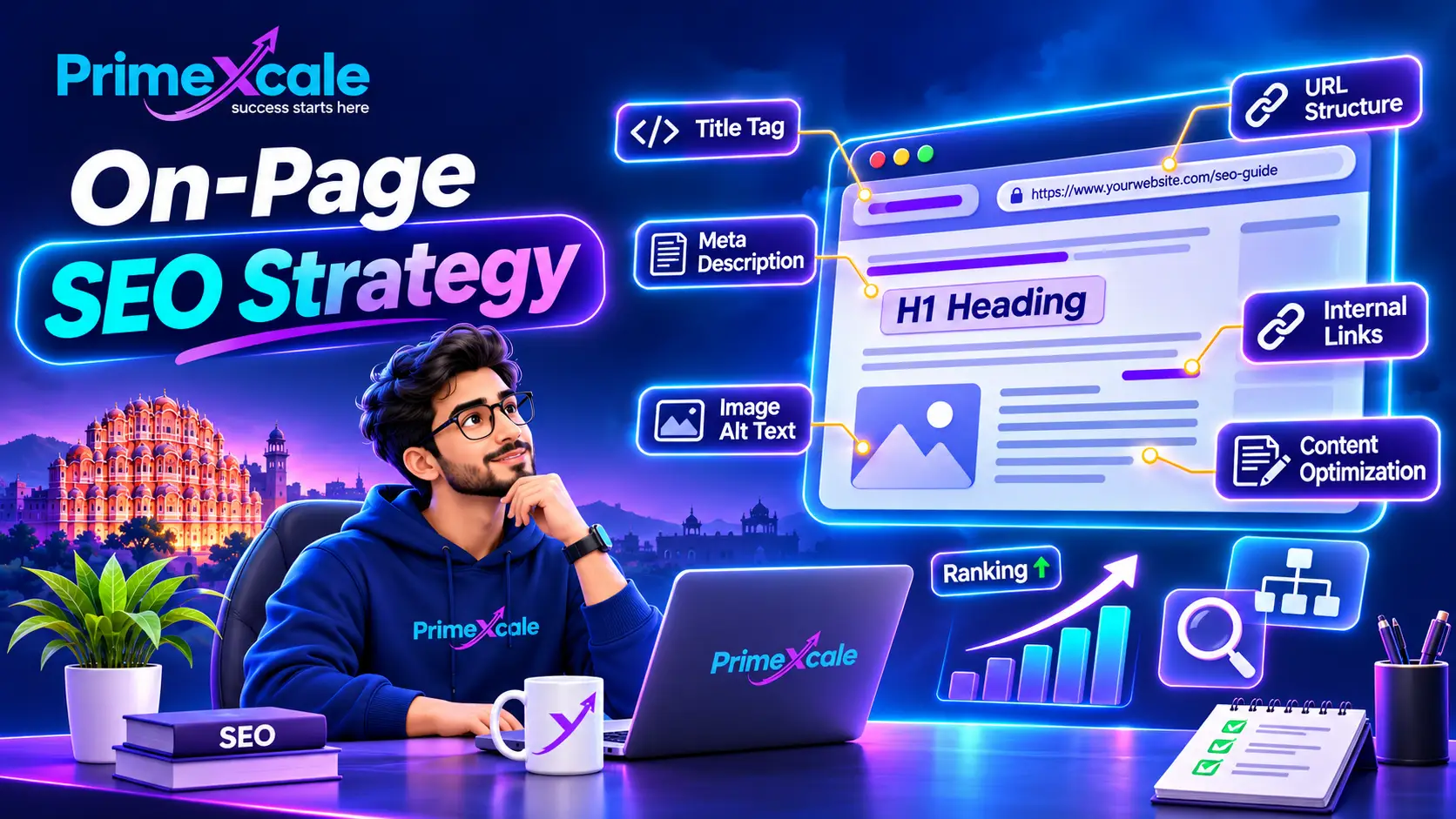
Step 3: Title Tag Optimization, Meta Description Best Practices and URL Structure
These three are what people see before they reach your site.
Title tag optimization: about 50 to 60 characters, keyword near the front. “Home | Services | SEO | Best SEO Company” is a keyword dump. “On Page SEO Strategy: Step-by-Step Guide for 2026” says what you get.
Meta description best practices: 130 to 150 characters. It won’t lift rankings directly, but it decides clicks. Say what the reader gets and end with a nudge.
URL structure: short, lowercase, hyphens. /on-page-seo-strategy beats /blog/2026/03/post?id=4821.
Step 4: Use Header Tags Properly
Use one H1 with your main keyword, H2s for sections and H3s for points inside them, with no skipped levels. Good heading structure is simple: write header tags that say what the section answers, and phrase some as real questions. Read only your headings. If they tell the story of the page, it works.
Step 5: Content Optimization and E-E-A-T
Check the top five results and note what they all cover. Then find what they miss, which is often a real example. Content optimization isn’t about keyword counts. It’s about answering the question better than the pages already ranking.
Show that a real person wrote it. Add an author name, share things you’ve tried and put a last-updated date on the page. That’s E-E-A-T (experience, expertise, authoritativeness, trust). It isn’t a direct ranking factor, but it’s what Google’s quality guidelines reward. Keep paragraphs short and put the answer first.
Step 6: Internal Linking Strategy and Topic Clusters
A good internal linking strategy tells Google which pages matter and keeps readers moving. Use descriptive anchor text like “keyword research guide,” not “click here,” and give every new page two or three links from existing ones. Build topic clusters too: one pillar page, with supporting posts linking up to it and the pillar linking back down. Check for orphan pages that nothing links to. When you quote a statistic, point to the original source.
Step 7: Image Alt Text, Page Speed and Core Web Vitals
Compress images before uploading, use WebP and name files properly (on-page-seo-checklist.webp, not IMG_4821). Write image alt text that simply describes the picture.
Many searches in India happen on phones, so test mobile first. The Core Web Vitals targets are LCP under 2.5 seconds, INP under 200 milliseconds and CLS under 0.1. PageSpeed Insights shows where you stand.
Step 8: Add Schema Markup
Schema markup is structured data that helps search engines read a page’s details. It won’t boost rankings alone, but it can earn richer results. For a blog post, add Article and breadcrumb schema. Use JSON-LD and test it in Google’s Rich Results Test first.
On Page SEO Checklist
- Checked Search Console for pages with low CTR
- Matched the page to search intent, one keyword per page
- Rewrote title tag, meta description and URL
- One H1 and a clean H2 and H3 structure
- Covered the topic, with an author name and date
- Added internal links and checked for orphan pages
- Compressed images, added alt text, tested mobile
- Added and tested schema
Common On-Page SEO Mistakes
- Keyword stuffing: write for people and use variations.
- Duplicate titles: give every page its own.
- Thin content: expand it or merge it.
- Ignoring intent: check the live results first.
- Broken links: crawl your site every few months.
How to Measure On Page SEO Results
Give changes 4 to 8 weeks. In Search Console, compare the same dates before and after and watch impressions, clicks, position and CTR. In Google Analytics, check organic sessions and conversions. Keep a log of what you changed and when. If nothing moves, go back to Step 2. It’s usually intent, not a missing keyword.
FAQs
Title changes can show movement in 2 to 4 weeks once Google recrawls the page. Bigger content updates usually take 4 to 8 weeks or more.
Yes. AI search pulls from clear, well-structured, trustworthy pages, which is exactly what good on page SEO produces.
Review key pages every 3 to 6 months, or sooner if rankings drop or a competitor publishes something better.
One Response